A father of eight who ran toward gunfire may have saved 140 children, but the story being built around him now will shape how America thinks about hate, security, and truth itself.
Story Snapshot
- A security guard’s final stand likely stopped a school massacre inside San Diego’s largest mosque.
- Two teenage attackers, later found dead, left behind weapons, writings, and a trail of online hate.[4]
- Officials quickly framed the shooting as a hate crime and a case of online radicalization.[4]
- The public still has not seen the core evidence that underpins the official narrative.[1][4]
A Security Guard’s Last Sprint And The Children Behind The Door
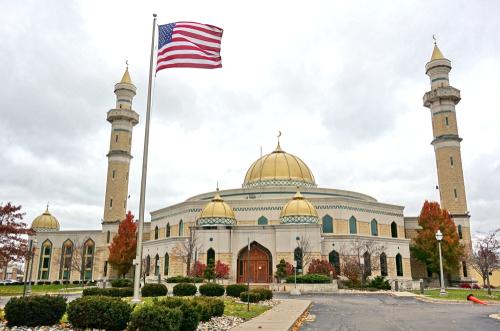
Police say when the first shots cracked across the Islamic Center of San Diego’s campus, security guard Amin Abdullah did not hide; he advanced.[3][4] The center houses the Al Rashid School, with roughly 140 children on site that day, and Abdullah’s job suddenly shrank to one task: buy them time.[4] According to San Diego’s police chief, he engaged the teenage gunmen in a gun battle that delayed, distracted, and deterred them from reaching the classrooms, then triggered lockdown.[3][4]
Imam Taha Hassane, the mosque’s director, described Abdullah as the shield between two armed teenagers and an entire community.[4] Police credit his actions with forcing the attackers to focus on him and on adults in the parking lot rather than streaming into the school building.[3][4] Conservative instincts about personal responsibility and courage find a clear example here: one man, properly trained and willing to act, changed the math in those crucial seconds far more than any hashtag or slogan ever could.
Victims With Names, Stories, And A Few Seconds Of Warning
Authorities and the imam identified three adults who never came home: Abdullah, Mansour Kaziha, known as Abu’l-Izz, and Nadir Awad.[3][4] Hassane said Kaziha was the first to dial 911, calling authorities before he was killed.[4] Awad, along with Kaziha, reportedly drew the suspects’ attention in the parking lot, buying more time for others to escape or hunker down.[3][4] Their actions show how ordinary congregants, not just uniformed officers, can become the last line of defense when seconds matter.
Police and city officials have framed these men as protectors who consciously moved toward danger.[3][4] That picture aligns with what many Americans still quietly believe about duty: you protect your neighbor, even when the odds are ugly. Yet the very intensity of this hero narrative can create a blind spot. Once the public locks onto an emotionally satisfying storyline—heroes versus hateful killers—there is a tendency to stop asking hard questions about everything that happened before the first shot and everything claimed afterward.
Teenage Gunmen, A Runaway Call, And A Heap Of Weapons
Officials say the attackers were 17 and 18 years old.[4] Earlier that morning, a mother called police to report a runaway juvenile, missing guns, and a vehicle; she said her son was with a companion wearing camouflage. Officers used license plate readers to track that vehicle and alerted a local high school because of the suspect’s ties there. Hours later, shots erupted at the Islamic Center, and the same teens were identified as the prime suspects.
Police and the Federal Bureau of Investigation (FBI) say the pair met online, discovered they both lived in San Diego, and eventually connected in person.[1] After the attack, investigators executed multiple search warrants at locations linked to them and reported seizing more than thirty guns, a crossbow, ammunition, tactical gear, and electronics.[1][4] To most citizens, that arsenal supports the sense that these teens did not just “snap”; they were stockpiling and planning, in a way that fits a familiar pattern of self-radicalized young men marinating in digital hate.
Hate, A Recovered Manifesto, And The Online Radicalization Label
During one briefing, an FBI special agent confirmed that investigators recovered a manifesto and other writings from the suspects’ vehicle.[1] Officials say those writings reveal a broad hatred that cuts across races and religions, not only toward Muslims, even though the attackers chose a mosque in a city that is majority white.[1] Authorities have publicly said they are investigating the shooting as a hate crime and that the suspects appear to have been radicalized online.[4]
❌ FALSE
Musk posted: "San Diego police are refusing to name yesterday's mosque shooters"
The claim is not supported by current…
📰 San Diego Police Department / press briefing coverage via YouTube · AP News — Coverage of the San Diego Islamic center shooting#factcheck
— Truth Checker (@truthcheckr) May 19, 2026
Here is where common sense and caution need to sit at the same table. The fact that federal agents and city leaders see evidence of hateful ideology and digital radicalization should be taken seriously; these institutions handle such cases regularly.[1][4] Yet the public has not seen the manifesto, the posts, or the chat logs they reference.[1][4] For now, the country is being asked to trust labels—“hate crime,” “radicalized online”—without access to the underlying exhibits that would let citizens independently confirm the fit.
When Briefings Become The Story Before The Evidence Arrives
Almost everything the public currently “knows” about this shooting comes from press conferences, not from primary case documents.[1][2][4] Reporters relay what police, the mayor, the imam, and FBI spokespeople say, often in real time, under intense pressure to fill airtime.[1][2] Early live coverage even flagged that key details were unconfirmed and that the situation was still “active but contained,” which shows some journalistic restraint.[2] Yet once officials settle on a coherent narrative—heroic guard, hate-fueled teens, online radicalization—that version tends to harden quickly.[1][4]
That dynamic should bother anyone who cares about both security and liberty. American conservative values emphasize honoring courage, punishing evil, and also demanding transparency from government. Those principles are not in conflict. Citizens can celebrate Abdullah’s sacrifice, mourn Kaziha and Awad, and still insist on seeing dispatch logs, body camera footage, warrant inventories, digital forensic summaries, and the actual text of the alleged manifesto once the immediate investigation phase passes.[1][4] Demanding evidence does not desecrate the dead; it protects the living from lazy narratives and future policy mistakes.
What Accountability Should Look Like After The Vigils End
Several basic questions remain unanswered in the public record. How exactly did investigators connect the morning runaway-juvenile call to the eventual attack, minute by minute? Did school and mosque protocols work exactly as designed, or did improvisation by staff and congregants save the day? What in the seized arsenal and digital data shows planning for this specific target versus a more diffuse desire for carnage?[1][4] And are there any signs of outside encouragement, copycat influences, or group involvement beyond the two dead suspects?
Local agencies and the FBI understandably guard some details while interviews, autopsies, and forensic work are underway.[1][4] But once charges are impossible—because the suspects killed themselves—there is less excuse for keeping the core evidence sealed forever. A culture that praises “see something, say something” should be equally comfortable with “show something, prove something.” The San Diego case will be remembered for a guard who ran toward bullets; it should also be remembered for whether citizens insisted on seeing the full truth he died inside of.
Sources:
[1] YouTube – WATCH: San Diego officials hold press briefing on deadly …
[2] Web – WATCH LIVE: San Diego police update on deadly mosque …
[3] YouTube – San Diego shooting: victims identified in mosque attack
[4] YouTube – ‘They tried to protect’: Islamic Center Imam identifies victims …