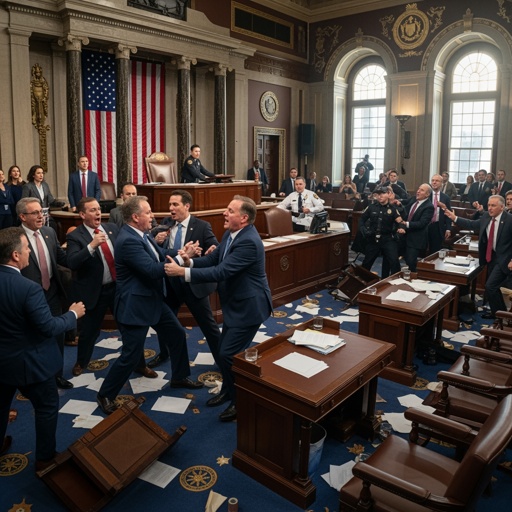
When four Senate Republicans joined Democrats to kill the SAVE America Act’s voter ID and citizenship checks, they signaled that protecting noncitizen access to the ballot mattered more than securing your vote.
Story Snapshot
- The SAVE America Act would require proof of U.S. citizenship and valid ID to register and vote in federal elections.
- The bill passed the House but failed in the Senate after a handful of Republicans broke with President Trump.[2][4]
- Left-leaning groups claim the bill is “voter suppression,” arguing it would burden millions of citizens lacking documents.[2][3][5]
- Conservatives warn that without voter ID and citizenship proof, the integrity of federal elections and trust in the republic are at risk.[4]
What the SAVE America Act Was Designed to Do
The Trump White House describes the SAVE America Act as a “common sense, bipartisan bill” built on one simple principle: American citizens, and only American citizens, should decide American elections.[4] The bill text, labeled House Resolution 22, amends the National Voter Registration Act to require documentary proof of United States citizenship before any state can register someone to vote in a federal election.[4] That proof includes items such as a birth certificate, passport, or similar citizenship documents, presented at the time of registration.[4][5]
The White House summary highlights three core pillars: a valid ID requirement before registering for a federal election, explicit proof of citizenship, and a ban on universal mail-in ballots except for illness, disability, military service, or travel.[4] Supporters argue that these measures close loopholes that allow noncitizens to slip onto voter rolls through lax registration processes or mail-in systems not designed to verify status.[4] The legislation also directs states to systematically remove noncitizens from voter rolls, tightening list maintenance rules that critics say have been ignored for years.[4]
How the Left Framed the SAVE Act as “Voter Suppression”
Opponents on the left did not seriously dispute that the SAVE America Act requires documentary proof of citizenship and tighter voter identification rules.[2][3][4][5] Instead, they attacked those very requirements as dangerous barriers. The Brennan Center for Justice claimed that in every version, the SAVE framework would force Americans to show documents such as passports or birth certificates to register, and argued that more than 21 million citizens lack “ready access” to such paperwork.[2] Advocacy groups insisted that this would “block millions of Americans from voting.”[2][3][6]
Organizations including Nonprofit Vote and the Legal Defense Fund called the measure “the wrong solution for a non-problem,” asserting that noncitizen voting is rare and that current law already requires applicants to affirm citizenship under penalty of perjury.[5][3] Civil rights and progressive voting groups further claimed the law would fall hardest on low-income renters, seniors, and minority communities who may struggle to produce documents on demand.[1][3][5] Mayors and local officials, organized by national city networks, urged the Senate to oppose any federal bill that restricted voter registration with new documentation mandates.[1]
Why Some Republicans Broke Ranks and What It Means
After the House passed the SAVE America Act on February 11, 2026, Senate Democrats made defeating it a top priority, backed by a broad coalition of left-leaning advocacy groups.[2][3][6] Under intense pressure and relentless media framing that branded the bill as “anti-voter,” several Republicans crossed the aisle to join Democrats in blocking the measure from advancing.[6] That Senate failure echoed an earlier collapse of the related Safeguard American Voter Eligibility Act in 2025, when upper-chamber opposition likewise stalled the effort.[1][2]
Election-law groups that cheered the bill’s defeat admitted it would have been “one of the most restrictive” federal voting changes in recent history precisely because it demanded hard proof of citizenship at registration.[1][6] For conservative voters, the message is clear: even with a White House committed to voter ID, elements within Congress remain willing to side with activists who treat basic citizenship verification as an unacceptable hurdle. The pattern reinforces a long-running divide, where one side stresses fraud prevention and citizenship enforcement, while the other focuses on paperwork burdens and potential registration errors.[5][1]
Election Integrity, Illegal Immigration, and the Future of the Republic
Neutral policy analysts acknowledge that this fight follows a recurring pattern in American election debates: one camp frames laws like the SAVE America Act as necessary citizenship verification, while the other labels them as registration barriers that might suppress eligible voters.[5][6] Everyone agrees that noncitizens are not legally allowed to vote, but the dispute centers on whether proof-of-citizenship requirements are a proportionate response, given the documented rarity of confirmed noncitizen registrations and the administrative costs.[5][1] Conservative backers argue that even limited noncitizen voting is intolerable when every close race matters.
From a constitutional, limited-government perspective, many right-leaning Americans see documentary proof of citizenship and strong voter identification as the minimum safeguard for a legitimate republic.[4] If millions can register without ever presenting concrete evidence of citizenship, confidence in election results erodes—especially in an era of mass illegal immigration and expansive mail-in voting. The SAVE America Act’s defeat in the Senate, after a handful of Republicans sided with Democrats, leaves that concern unresolved and deepens grassroots frustration that Washington still refuses to match voter rolls to the basic standard summed up in one phrase: no voter ID, no republic.
Sources:
[1] YouTube – “No Voter ID, No Republic” – SAVE Act FAILS After RINOs Turn On Trump
[2] Web – Nearly 60 bipartisan election officials express their opposition to …
[3] Web – House Passes New Version of the SAVE Act
[4] Web – Five Things to Know About the SAVE America Act
[5] Web – The SAVE America Act – The White House
[6] Web – In Victory for Voters, the SAVE America Act Fails in the Senate